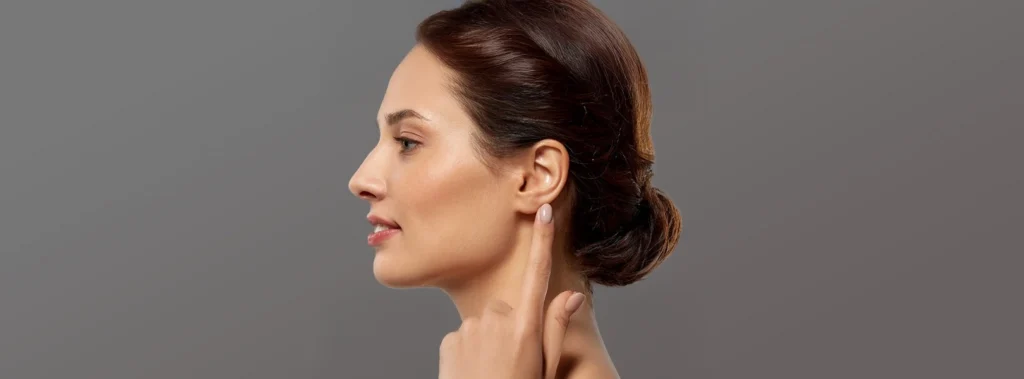
Otoplasty, also called prominent ear surgery or ear pinning surgery, reshapes or repositions the outer ear to reduce projection or address selected contour differences. It can be considered in children and adults after an individual assessment, while recovery commonly includes a protective dressing and temporary headband use.
- Prominent ears usually relate to the shape, fold or position of the outer-ear cartilage rather than to hearing function.
- Otoplasty may use cartilage-folding sutures, selected cartilage modification or a combination tailored to the ear anatomy.
- Ear development is often described as largely complete between ages 4 and 6, so otoplasty may be considered from childhood as well as in adulthood.
- Early ear moulding may be an option for selected newborns, whereas tapes and headbands do not permanently reshape established ear cartilage.
- Recovery after otoplasty includes a protective dressing, temporary headband use and follow-up to monitor healing and ear position.
Prominent ears are a common variation of outer-ear shape in which one or both ears project further from the head than the surrounding facial proportions suggest. Otoplasty, the surgical procedure used to reshape or reposition the outer-ear cartilage, is one option considered for this appearance in children and adults after individual assessment.
What are prominent ears?
Prominent ears are ears that project farther from the side of the head than is typical for that individual’s facial proportions. In clinical language this presentation is described as prominent ear deformity or auricular prominence, terms that refer to the shape and position of the outer ear rather than to any illness.
The appearance may involve one ear or both, and the two sides are often not identical, so a degree of asymmetry can form part of the picture. Prominence usually relates to the angle between the outer ear and the scalp, to the shape of the ear cartilage, or to both together. An angle of less than about 35 degrees between the outer ear and the skull, and a distance of less than about 2 cm between the rim of the ear and the side of the head, are traditionally described as typical. Above these values the ear tends to look prominent, although they are planning measurements rather than a universal standard of normal appearance.
Because prominent ears concern the visible outer ear, they do not in themselves indicate a hearing problem. Ear shape that differs from the average does not require treatment, and the decision to seek assessment is a personal one.
What causes prominent ear deformity?
Prominent ear deformity most often develops from differences in the shape, fold or position of the outer-ear cartilage. Several anatomical patterns are described: a less defined antihelical fold, which normally creates the gentle ridge of the upper ear; a relatively deep or prominent conchal bowl, which pushes the ear outwards; forward rotation of the whole auricle; or a combination of these features.
In everyday speech this is simply called prominent ears, and the underlying anatomy is the reason the appearance tends to be consistent over time rather than fluctuating. Ear shape can run in families, but family patterns do not predict the ear shape of every child. Parents with prominent ears may have children whose ears do not project, and prominent ears can appear with no known family history.
Growth generally does not make an established prominence less noticeable. As a child grows, cartilage becomes firmer and the existing shape tends to persist, although the course for an individual child depends on the underlying anatomy and is best judged on examination.
Who may consider prominent ear correction?
Prominent ear correction may be considered by children or adults who wish to change ear projection, ear shape or noticeable asymmetry. Motivation varies widely: some people have thought about it for years, others are prompted by a hairstyle change or by a child’s own comments. Timing and reasons are individual, and there is no obligation to act on appearance alone.
An assessment looks at the nature of the ear shape, the flexibility of the cartilage, skin quality, the degree of symmetry between the two sides, any previous ear procedures, general health and the person’s own goals. Ears that protrude, ears that tilt forward and certain contour differences in the upper ear may be evaluated for surgery, but not every ear concern is treated in the same way, and the suitability of any plan is decided after examination by a plastic surgeon.
It is also worth separating different parts of the ear. A large, elongated or downward-hanging earlobe is a distinct anatomical issue from upper-ear prominence, and earlobe reduction is assessed separately because it addresses soft tissue rather than cartilage position. In some people both features are present, in which case each is evaluated on its own terms.
When can otoplasty be performed?
Otoplasty can be performed once ear growth and cartilage development allow a stable surgical plan, often from childhood through adulthood. The anatomical structure of the ear is described as largely complete between the ages of 4 and 6, and surgeons have traditionally considered surgery around the age of 6, when the ear has reached close to adult dimensions.
Age alone, however, is not the deciding factor. A child’s development, ability to cooperate with dressings and aftercare, general health and the family’s own discussion all influence timing. Delaying surgery does not make it less feasible later, and there is no fixed upper age limit. In adults the cartilage is usually firmer and less willing to bend, which can influence technique selection and fixation; the planning of otoplasty for adults and children therefore differs mainly in technique, anaesthesia and aftercare.
For school-age children, the timing of surgery is often discussed in relation to teasing. Studies of children with prominent ears describe effects on self-esteem and social life, and many surgeons place weight on the child’s own wish for correction rather than on the parents’ preference alone. Carrying out the operation before starting school, or during a long school holiday, allows the headband period to pass with less attention.
The first consultation covers medical history, regular medicines, allergies, bleeding tendencies, previous ear surgery or trauma, and, where relevant, smoking or nicotine exposure, which can affect wound healing. The desired degree of correction is discussed openly, since expectations differ: some people want a subtle reduction in projection, others a more defined fold. Photographs and measurements of the ear may be used to support planning. No particular final appearance can be promised, and both ears rarely become perfectly identical.
How is prominent ear surgery performed?
Prominent ear surgery reshapes or repositions the outer-ear cartilage through an incision usually placed behind the ear. The operation, known medically as otoplasty and sometimes called ear pinning surgery, is planned around the individual’s anatomy rather than following one standard approach.
Two broad techniques are commonly described. The first modifies the cartilage itself, scoring or selectively removing cartilage so that it sits in a new position. The second uses sutures to fold and hold the cartilage in a reshaped form without cutting it. These may be used alone or combined in appropriate cases, depending on how stiff the cartilage is and which part of the ear is responsible for the prominence.
A typical sequence involves anaesthesia, an incision behind the ear to expose the cartilage, reshaping or repositioning of that cartilage, fixation with sutures where used, closure of the skin and placement of a protective dressing. Not every case involves cutting cartilage. Local anaesthesia is generally suitable for adults, while general anaesthesia is often preferred for children so that they remain still throughout. The procedure usually takes one to two hours for both ears, depending on the technique and how much reshaping is needed.
Many adults return home on the same day. Children are often kept until the following day, and an adult whose procedure has been more complex may occasionally stay overnight as well.
Is prominent ear correction without surgery possible?
Prominent ear correction without surgery may be possible for some newborns through early ear moulding, but it is generally not a permanent option for older children or adults. Newborn cartilage is temporarily softer and more mouldable, influenced by circulating maternal hormones, and splinting or moulding devices can sometimes guide it into a different shape.
Timing matters. The first three days after birth are described as particularly important, and the chance of success is thought to fall as hormone levels decline and the cartilage stiffens. Whether moulding is suitable at all, and for how long it should continue, requires clinical assessment rather than a fixed rule.
In older children and adults, headbands, tape and adhesive devices may camouflage ear projection temporarily, but they do not permanently reshape cartilage that has already set. Adhesives and tapes can cause skin irritation or allergic reactions in some people, so professional advice is sensible before prolonged use. Newborn moulding and surgery are different interventions for different stages of life, and early moulding should not be presented as an alternative to surgery at every age.
Prominent ears in babies
Prominent ears in babies can sometimes be assessed soon after birth, when the outer-ear cartilage may still be flexible enough for moulding approaches. Parents may notice ears that stand away from the head, an upper rim that folds over, or a visible difference between the two sides.
Newborn ear shape can change during the early weeks, so part of the assessment is distinguishing a temporary variation caused by position in the womb from a persistent structural difference in the cartilage. Where parents are considering moulding, prompt professional review is particularly relevant, because the window in which cartilage responds well is short.
If that window has passed, assessment usually shifts to observation and, much later, a discussion about whether surgical reshaping is wanted. Not every baby with a projecting ear needs any intervention, and a decision based on appearance alone, without examination, is not advisable.
How long is otoplasty recovery?
Otoplasty recovery involves an initial protective dressing followed by a period of headband use. A typical course looks like this:
- First three days: a padded head bandage applied at the end of surgery stays in place. Patients rest at home, and mild aching is usually controlled with simple pain relief.
- Day three or four: the bandage is removed at the first check, the ears are inspected and a soft headband is started. Hair can usually be washed gently from this point.
- First week: staying at home for about a week is advised. Adults usually return to desk-based work after six to seven days, and children to school after about a week. If removable sutures were used, they are taken out at around one week.
- Three weeks: the headband is worn for an average of three weeks, day and night at first and then mainly at night, to protect the ears from being folded forward during sleep.
- Six weeks onwards: contact sports and activities with a risk of knocks to the ears are resumed, and swelling has largely settled.
Most of the practical questions in the first weeks concern the headband, sleeping position and getting back to normal life, and otoplasty recovery time varies most with the type of work or school activity involved.
Early swelling, bruising, tenderness and temporary changes in skin sensation around the ear are common and usually settle gradually. Pain relief or antibiotics may be prescribed when clinically indicated rather than as a routine for everyone. Surgeons typically advise sleeping on the back to avoid pressure on the ears and protecting the ears from knocks or pulling. Follow-up appointments are used to check wound healing, dressings and the position of the ears.
What are the risks of otoplasty?
Otoplasty carries surgical risks that are uncommon but should be discussed in relation to the person’s anatomy and planned technique. Reported complications include infection, bleeding or haematoma beneath the skin, blood clots, wound-healing problems, visible or raised scarring, suture-related irritation or extrusion, altered skin sensation, asymmetry or contour irregularity, partial recurrence of the prominence and the possible need for revision surgery.
Pain and swelling during the recovery period are expected and are not in themselves evidence of a complication; new, worsening or one-sided symptoms should be assessed by the operating team. Scars are commonly placed behind the ear, where they are less visible in normal view, and they often become less noticeable over time; how a scar matures differs from person to person and depends on skin characteristics and wound care.
A small degree of recurrence, in which the ear moves slightly back towards its original position, is possible in the first months, particularly when cartilage is stiff or the correction relies on sutures alone. When it is noticeable, revision otoplasty can adjust the result once healing is complete.
Whether surgery is appropriate, and which technique suits a particular ear, is determined by examination and ear analysis carried out by Prof. Dr. Şükrü Yazar.
Other ear shapes and reconstruction
Otoplasty is not limited to ears that stand out. The same principles are used for a cup ear, in which the upper rim is folded and small, for a lop ear, in which the top of the ear bends forward, and for an ear with an extra fold in the upper cartilage. Differences in size or position between the two ears can also be balanced during the same operation.
When part of the ear is missing, the situation is a reconstructive one. Ear reconstruction may be needed after trauma, a dog bite or a burn, and after skin cancer surgery on the ear. A small or underdeveloped ear present from birth, known as microtia, is treated with staged microtia reconstruction using rib cartilage, which is a different operation from otoplasty.
Adults sometimes choose to combine otoplasty with another facial procedure such as rhinoplasty in a single anaesthetic. Whether this is sensible depends on the length of surgery and the aftercare each procedure needs.
Prominent ear correction in Istanbul: planning the stay
Adults can usually have otoplasty under local anaesthesia and leave the same day, which makes a short trip to Istanbul practical. A stay of about a week is recommended, allowing the bandage check on day three or four and suture removal around day seven before the flight home. Flying is fine once the bandage has been replaced by the headband.
For children, surgery is performed under general anaesthesia with one night in hospital, and a parent stays throughout. Photographs of the ears from the front, side and back allow a provisional plan before travel, and the final decision is made at the in-person examination.
Questions patients ask about otoplasty
Does otoplasty cause hearing loss?
The procedure is performed on the outer ear and is not intended to affect hearing. Hearing concerns, unusual pain, discharge or other postoperative symptoms need assessment by the surgical team.
Is prominent ear deformity inherited?
Prominent ears can occur in families, but inheritance is not predictable for every parent and child. Ear shape may also occur without a known family history.
Do prominent ears improve as a child grows?
Established ear prominence often remains as the cartilage grows and becomes firmer. The likely course for an individual child depends on the underlying ear shape.
Does the operation leave scars?
A scar is commonly left behind the ear, where it is less visible in normal view. Scar healing varies between individuals and depends on wound care and skin characteristics.
Are the results permanent?
Yes, for most patients the ear does not return to its original shape. A slight degree of settling is possible in the first months, depending on cartilage stiffness and technique, and a noticeable recurrence can be corrected with a revision.
How long is a headband worn after surgery?
A soft headband is worn for an average of three weeks after the initial bandage is removed, at first day and night and later mainly at night. The precise schedule follows the operating surgeon’s instructions.
Can adults have otoplasty under local anaesthesia?
Yes. Most adults have the operation under local anaesthesia and go home the same day. General anaesthesia is usually preferred for children so that they stay still throughout.
When can a child go back to school after otoplasty?
Usually after about a week, once the bandage has been replaced by a headband. Contact sports and rough play are avoided for around six weeks.
References
- Ear Surgery — American Society of Plastic Surgeons
- Otoplasty for prominent ear: a systematic review of surgical techniques — JPRAS Open (2026)
- Complications of cartilage-sparing otoplasty: a systematic review and meta-analysis — Journal of Craniofacial Surgery (2024)
- The psychological, social and educational impact of prominent ears: a systematic review — Journal of Plastic, Reconstructive and Aesthetic Surgery (2020)
- Ear molding in children: timing, technique and follow-up, a systematic review — Facial Plastic Surgery and Aesthetic Medicine (2024)
Professor Şükrü Yazar, Consultant Plastic, Reconstructive and Aesthetic Surgeon, performs otoplasty for children and adults at his practice in Nişantaşı, Istanbul.
The information here is for guidance only and does not replace examination, diagnosis or treatment.