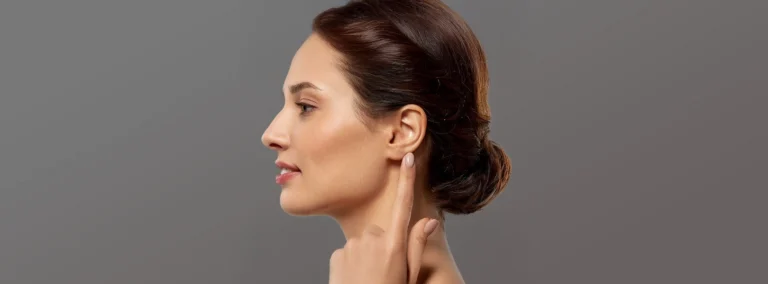
Earlobe reduction is a surgical procedure that removes and reshapes excess earlobe soft tissue to address enlarged, elongated, stretched or torn earlobes. It is commonly performed under local anaesthesia, and the technique, scar pattern, recovery and suitability depend on the individual ear anatomy and healing factors.
- Earlobe reduction reshapes the soft lower part of the ear and is different from otoplasty, which addresses ear cartilage and prominence.
- Enlarged, elongated, stretched and torn earlobes may require different incision patterns and amounts of tissue removal.
- Earlobe reduction surgery is commonly performed under local anaesthesia and generally takes 30–60 minutes.
- Scar visibility usually changes gradually, with marks often most noticeable in the first 2–3 months and fading over a longer period.
- Heavy earrings, trauma, skin quality and individual healing can affect the long-term appearance of an earlobe after surgery.
Earlobe reduction, also called earlobe reduction surgery or earlobe reshaping, is a short procedure in which excess soft tissue of the lower ear is removed and reshaped so that the lobe sits in better proportion with the ear and the face. It is performed under local anaesthesia in 30 to 60 minutes, and most people return to their normal routine the same day.
What is earlobe reduction?
Earlobe reduction is a surgical adjustment of the soft lower portion of the ear, in which a planned amount of tissue is removed and the remaining lobe is contoured. Because the lobe contains no cartilage, the procedure differs from prominent ear correction, which reshapes the cartilage framework and the angle of the ear relative to the head.
People usually ask about the operation for one of a few reasons: naturally large lobes that have always looked out of proportion, gradual lengthening with age, stretching caused by years of heavy jewellery or ear gauges, or a torn and split lobe, where repair and reduction may be planned together. The intended shape, the amount of tissue to be removed and the position of the incision are decided during the surgeon’s examination.
Who may consider earlobe reduction surgery?
Earlobe reduction surgery may be considered by adults whose earlobes appear enlarged, elongated, stretched or noticeably asymmetrical and who wish to discuss surgical reshaping. It is an elective procedure, so the decision rests on how much the appearance of the lobe matters to the individual rather than on medical necessity.
Suitability depends on the nature of the concern, skin quality and laxity, previous piercings or trauma, how the person has healed from earlier wounds, general medical conditions and expectations. A personal or family history of raised scars after piercing is particularly relevant, because it changes how the incision is planned and followed up.
A consultation also reviews current medicines, supplements and herbal products, including blood-thinning medicines and herbal teas. These are not stopped on personal initiative; the prescribing clinician and the surgeon agree on an individual plan.
Earlobe changes with age and after a facelift
The earlobe is one of the few parts of the face that keeps lengthening throughout life. Skin loses elasticity, the free lower part of the lobe drops and the piercing hole often stretches into a slit. In people over sixty, a long earlobe can make the whole ear look larger and draw attention to other signs of ageing.
For this reason earlobe reduction is often combined with a facelift. The facelift incision already passes around the ear, and the surgeon can reshape the lobe and set its attachment to the cheek at the same time, avoiding the pulled-down, attached look that can follow when the lobe is not considered in the plan.
When the lobe is not long but has become thin, flat and wrinkled, removing tissue would make it smaller still. In that situation a small amount of hyaluronic acid filler can restore fullness and support an earring again, in the same way dermal fillers are used elsewhere on the face.
Torn, split and stretched earlobes
Heavy earrings, a sudden pull or years of wear can elongate the piercing hole until it forms a slit or splits the lobe completely. A partial tear is usually repaired by removing the lining of the elongated channel and closing it in layers. A complete split is closed with a small zigzag or notch design so that the lower edge of the lobe does not heal with a visible dent.
Lobes stretched by gauges or plugs are a separate problem: the opening may be large and the surrounding tissue thin. The stretched ring is removed and the lobe rebuilt from the remaining tissue, often combined with reduction so that both ears end up similar in size. When most of the lobe has been lost to injury, the situation becomes one of ear reconstruction rather than reduction.
If the person wishes to wear earrings again, the repair can be planned so that a new piercing is made later in healed, solid tissue, slightly away from the scar line.
Earlobe reduction techniques
Earlobe reduction techniques remove a carefully planned amount of soft tissue and reshape the remaining lobe so that the lower ear keeps a natural contour. The pattern of the incision and the shape of the tissue removed are chosen according to what needs correcting: excess width, excess length, asymmetry between the two sides, stretching of a piercing channel, or an associated split that needs closing at the same time.
Where possible, the incision is placed along the front edge of the lobe or in the natural crease where the lobe meets the face, so that the scar sits where it is least visible. Earlobe reshaping aims to preserve an appropriate attachment to the side of the head and a soft, rounded lower edge, while avoiding a lobe that looks too small or unnaturally pointed after healing. Over-reduction is harder to correct than conservative reduction, so planning tends to be cautious.
Differences between the two ears can be assessed and improved, although natural asymmetry is normal and exact matching may not be achievable.
After healing, the aim is a lobe that is shorter or narrower, hangs naturally and blends into the cheek without a sharp angle. Both lobes are usually treated in the same session, which makes it easier to match their size and shape. The change is subtle in photographs taken from the front, but it is noticeable in profile, with the hair tied back and when wearing earrings.
How is earlobe reduction surgery performed?
Earlobe reduction surgery is performed under local anaesthesia, so the person remains awake and does not feel pain while only the earlobe and surrounding skin are numbed. Sensations of pressure or movement may still be noticed.

The planned shape is marked on the lobe while the patient is sitting upright, so that the natural hang of the tissue is taken into account. The marked excess soft tissue is then removed, the cut edges are trimmed and reshaped to follow the intended contour, and the incision is closed with fine sutures. Where a torn lobe is being repaired at the same time, the edges of the tear are freshened before closure.
The operation takes 30 to 60 minutes, depending on whether one or both lobes are treated and whether repair is combined with reduction. A small dressing is applied before the patient goes home, and there is no hospital stay.
Earlobe reduction recovery
Recovery is quick, and discomfort is usually mild enough to be managed with simple pain relief. A typical course looks like this:
- Same day: most people return to desk-based work or daily activities immediately after the procedure.
- Next day: showering and bathing are possible, keeping the incision clean as instructed.
- First week: pressure on the ears is avoided during sleep, and hair and clothing are kept from catching the sutures. If non-dissolving sutures were used, they are removed after about a week.
- First weeks: earrings are left out, and heavy earrings in particular are avoided while the tissue strengthens.
- Two to three months: the lobe can be pierced again, with the timing and placement confirmed at follow-up.
Scars are noticeable during the first two to three months, suture marks begin to fade after five to six months, and after one to one and a half years they usually become barely visible unless closely examined. Scar maturation varies with individual healing, skin characteristics and tension across the wound.
Possible complications after earlobe surgery
Earlobe reduction surgery can involve risks including bleeding, infection, delayed healing, a noticeable scar, residual asymmetry, a small notch at the lower edge or dissatisfaction with the final shape. In some cases the wound may separate, sensation around the lobe may be altered for a period, or a minor revision may be discussed; these are possibilities rather than expected outcomes.
The earlobe is a common site for keloids, thick raised scars that can follow piercing or surgery. People who have formed a keloid before are assessed carefully, and keloid removal and recurrence prevention, such as steroid injections after surgery, may be planned from the start. An existing earlobe keloid can itself be removed as part of scar revision surgery. Prompt contact with the clinic is sensible if there is increasing redness, worsening pain, discharge, fever or a wound that begins to open.
The tissue removed does not grow back. The lobe can still change over the years, however, as ageing, skin laxity, injury or renewed traction from heavy earrings affect the soft tissue. Whether the procedure is appropriate is determined by the examination carried out by Prof. Dr. Şükrü Yazar.
When the whole ear looks large
Sometimes the concern is not the lobe alone but the size of the entire ear. Large ears can be made smaller by removing a wedge of skin and cartilage from the outer rim, a procedure also carried out under local anaesthesia in 30 to 60 minutes. Where the ear stands away from the head rather than being large, otoplasty to set the ear back is the more appropriate operation, and the two can be combined with earlobe reduction when needed.
Earlobe reduction in Istanbul: a short stay
Because earlobe reduction is performed under local anaesthesia with no hospital stay, it fits easily into a short visit to Istanbul. Photographs of both ears from the front and side allow a provisional plan before travel, and the final plan is agreed at the examination on the day.
Flying is possible the next day. A stay of two to three days allows a wound check before departure; if non-dissolving sutures are used, a stay of about a week, or removal by a local doctor at home, is arranged. Earlobe reduction is also often added to a facelift or neck lift during the same trip.
Questions patients ask about earlobe reduction
Does earlobe reduction surgery leave scars?
The operation leaves a fine incision scar, which is most visible during the first two to three months. Suture marks begin to fade after five to six months and usually become barely noticeable after one to one and a half years.
Is earlobe reduction painful?
The procedure is done under local anaesthesia, so only the injection of the anaesthetic is felt. Afterwards, discomfort is usually mild and controlled with simple pain relief.
Can earlobes grow back after reduction surgery?
The tissue removed does not grow back. However, ageing, skin laxity, trauma or repeated traction from heavy earrings can affect the appearance of the earlobe over time.
How long does earlobe reduction surgery take?
The procedure takes 30 to 60 minutes under local anaesthesia, depending on whether one or both lobes are treated and whether a torn earlobe is repaired at the same time.
When can ears be pierced after earlobe reduction?
Waiting at least two to three months before piercing is recommended. The new piercing is placed in healed, solid tissue slightly away from the scar line.
Can a torn earlobe be repaired during earlobe reduction?
Yes. A torn or split earlobe is often repaired and reshaped within the same operation. The design depends on whether the tear is partial or complete and how much tissue remains.
Are both earlobes reduced at the same time?
Usually yes. Treating both lobes in one session under local anaesthesia makes it easier to match their size and shape, and recovery takes no longer than for a single ear.
Can men have earlobe reduction?
Yes. Men most often ask about lobes stretched by gauges or lobes that have lengthened with age. The technique is the same, with attention to a slightly broader lobe shape that suits a male face.
References
- Ear Surgery — American Society of Plastic Surgeons
- Addressing earlobe elongation: a systematic review of surgical reduction techniques in the aging population — Plastic and Reconstructive Surgery Global Open (2025)
- Aesthetic earlobe reduction: a practical geometric modification with natural contour preservation — Facial Plastic Surgery (2019)
- Split earlobe repair with piercing preservation and optimal earlobe aesthetics — Journal of the American Academy of Dermatology (2019)
- Nonsurgical treatment of earlobe aging with hyaluronic acid fillers — Journal of Cosmetic Dermatology (2019)
Professor Şükrü Yazar, Consultant Plastic, Reconstructive and Aesthetic Surgeon, performs earlobe reduction and repair at his practice in Nişantaşı, Istanbul.
The information here is for guidance only and does not replace examination, diagnosis or treatment.