A brow lift raises eyebrows that have descended with age, opening hooded eyes and softening forehead and frown lines. Endoscopic and temporal techniques use small incisions hidden in the hairline; most people return to work within two to three weeks.
- A brow lift raises a low, heavy brow and softens forehead and frown lines.
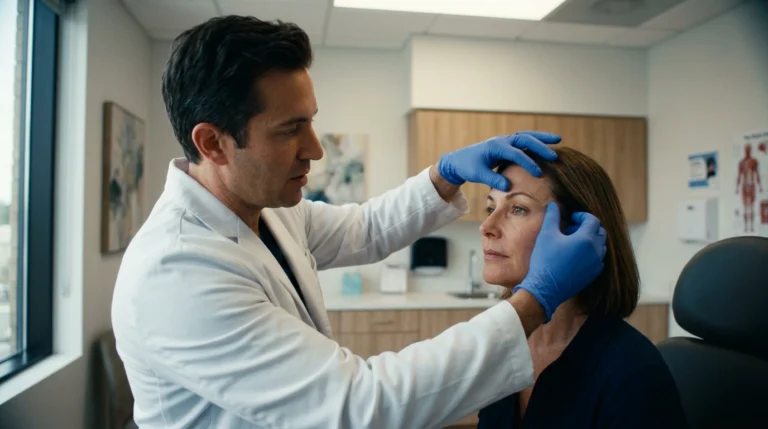
- Much of the hooding on the upper eyelid can come from the brow; lifting the brow with a fingertip shows which one is the cause.
- Endoscopic and temporal techniques hide short incisions in the hairline; a hairline incision suits very high foreheads.
- Stitches come out at about a week and most people return to work within two to three weeks.
- Botulinum toxin can lift the brow slightly for a few months but does not replace surgery for a clearly descended brow.
A brow lift, also called a forehead lift, raises eyebrows that have descended with age and softens deep lines across the forehead and between the brows. A low, heavy brow can make the eyes look hooded and the face look tired or even cross, and much of the heaviness that people notice on their upper eyelids actually comes from the brow above them. Lifting the brow back to a natural position opens the upper part of the face without changing its character.
Signs That the Brow Has Dropped
Brow descent usually starts at the outer end, where there is less muscle support. Common signs include a heavy fold of skin over the outer upper eyelid, a flat or sloping brow that once had a gentle arch, horizontal forehead lines from constantly raising the brows to see clearly, and frown lines between the eyebrows. People often describe looking tired or sad when they do not feel it.
Because the brow and the upper eyelid are so closely linked, it is important to tell which one is causing the problem. If the brow has dropped, removing eyelid skin alone can pull the brow even lower. Working out whether eyelid surgery or a brow lift is needed, or both, is the most important step in planning.
Brow Lift or Eyelid Surgery?
A simple test is to gently lift the eyebrow with a fingertip while looking in the mirror. If the hooded skin over the eyelid largely disappears, the brow is the main cause and a brow lift is likely to help. If loose skin remains on the eyelid even with the brow raised, upper eyelid surgery may be needed as well. Many people over fifty benefit from a combination, and the two operations can be done at the same time. When hooded eyes come from both the brow and the eyelid, treating only one usually leaves the result incomplete.
Measuring the Brow: What the Examination Looks For
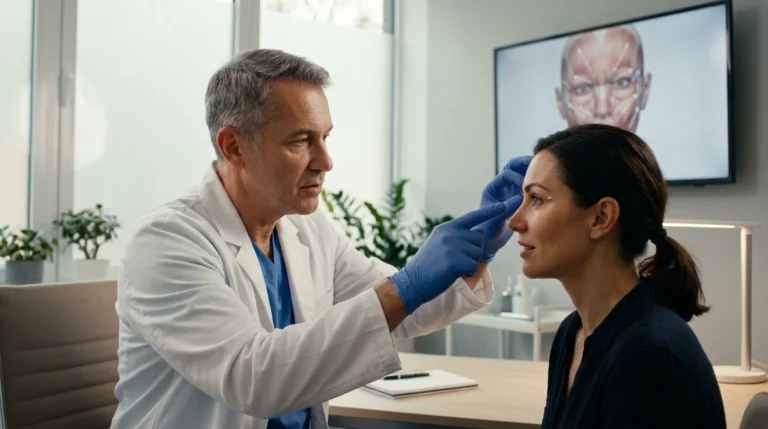
The examination measures the height of the brow above the upper eyelid crease and compares the inner, middle and outer parts of each brow, since descent is rarely even. Forehead height, the position and density of the hairline, the depth of forehead and frown lines, and any difference between the two sides are noted. Many people unconsciously raise their brows all day to keep their eyes open; when the forehead is relaxed during the examination, the true brow position becomes clear.
The upper eyelids, the eye surface and any dry-eye symptoms are checked as well, because a brow lift changes how the eyelids close for a short time after surgery. Photographs are taken and the planned change is discussed in millimetres: in most people a modest lift of the outer brow gives a fresher look without changing expression.
Endoscopic, Temporal or Hairline Brow Lift
- Endoscopic brow lift: three to five short incisions are made inside the hairline, and the brow is released and lifted using a small camera. Scars are hidden and recovery is relatively quick. It suits most people with a normal forehead height.
- Temporal (lateral) brow lift: short incisions in the temple hairline lift mainly the outer third of the brow, which is where descent is most visible. It is often combined with eyelid surgery. Compared with a full brow lift, it lifts less of the brow but needs shorter incisions.
- Hairline (pretrichial) brow lift: an incision along the front of the hairline allows the brow to be raised without moving the hairline further back. It is useful when the forehead is already high, and it is the approach used in a forehead lift that also shortens the forehead.
The choice depends on forehead height, hairline position, how much lift is needed and where along the brow it is needed. A more detailed look at endoscopic, temporal and traditional techniques shows how each one is carried out.
Who Benefits Most From Lifting the Brow
A brow lift suits healthy adults whose eyebrows sit noticeably lower than they used to, who have hooding that comes from the brow rather than the eyelid alone, or who have deep forehead and frown lines alongside brow descent. Good candidates are non-smokers or willing to stop, have realistic expectations and understand that the aim is a rested look, not a permanently surprised one. People with very high foreheads or thinning hair at the hairline need careful planning of the incision.
Before a Brow Lift: Smoking, Medicines and Hair Care
- Stop smoking and nicotine at least four weeks before surgery to protect healing of the scalp incisions.
- Review medicines and supplements that increase bleeding with the surgical team.
- Plan hair care: hair can usually be washed gently after two or three days; colouring and chemical treatments are postponed for about six weeks.
- Prepare for swelling: extra pillows to sleep with the head raised, cold packs for the eyes and a week without important social or work commitments.
Inside the Operation: Releasing and Fixing the Brow
A brow lift is usually performed under general anaesthesia or sedation and takes about one to two hours, longer when combined with eyelid surgery. After the brow is released from the underlying bone, it is lifted to the planned height and fixed in place with small dissolving devices or stitches. The incisions are closed and a light dressing or headband may be applied. Most people go home the same day or after one night.

Swelling Around the Eyes and Other Stages of Brow Lift Recovery
- Days 1–3: swelling of the forehead and around the eyes, sometimes with bruising that settles downwards towards the cheeks. Sleeping with the head raised and cold compresses help.
- Days 7–10: stitches or clips in the scalp are removed. Most bruising has faded by the end of the second week.
- Weeks 2–3: most people return to work and social plans.
- Months 1–6: numbness or itching of the scalp behind the incisions gradually improves as the nerves recover, and the brow settles into its final position.
Brow Lift With Eyelid Surgery or a Facelift
A brow lift is often combined with upper eyelid surgery: the brow is raised first, and only the eyelid skin that is still excess afterwards is removed, which avoids taking too much. When the lower face and neck have also aged, it can be combined with a facelift so that the upper and lower face are refreshed in proportion. Combined operations take longer and recovery is planned around the more extensive procedure.
Hidden in the Hairline: Brow Lift Scars
With endoscopic and temporal techniques the short incisions lie inside the hairline and are hidden by hair once healed. A hairline incision is placed just at the front edge of the hair and cut at an angle so that hair can grow through the scar, which makes it less visible over time. Scars are pink at first and fade over about a year; temporary thinning of hair along the incisions usually recovers within a few months.
How Long a Brow Lift Lasts
The more open, rested look is visible once swelling settles at around two to three weeks, and the brow reaches its final position over about three months. The repositioned brow is held as the tissues heal, so the result is long-lasting, although the forehead and brows continue to age naturally. Many people find the improvement holds for many years, especially when combined with protection from sun damage and avoidance of smoking.
Numbness, Hair Thinning and Other Brow Lift Risks
Possible risks include bleeding, infection, temporary or longer-lasting numbness of the forehead and scalp, hair thinning along the incisions, asymmetry between the two brows, visible scarring with hairline incisions and, rarely, weakness of the muscle that raises the brow. Over-correction, which creates a surprised look, is avoided by conservative planning. Most effects are temporary and settle as healing progresses.
Can Botox Lift the Brows Instead?
Botulinum toxin injected into the muscles that pull the brow down can raise the tail of the brow slightly and soften frown lines for a few months. Threads can give a small, temporary lift. These options suit mild heaviness or people who want to postpone surgery; they do not reposition a brow that has clearly descended. Lifting only the outer corner of the eye, as in almond eye surgery, is a different operation with a different aim.
Brow Lift Abroad: A Seven to Ten Day Plan
A brow lift fits well into a short stay: an in-person consultation and markings a day or two before surgery, the operation as a day case or with one night in hospital, and a check before flying home. Most people plan to stay about seven to ten days, until the scalp stitches or clips have been removed. Flying is generally possible after that check; some swelling and bruising around the eyes may still be visible.
Brow Lift Frequently Asked Questions
Will a brow lift make me look surprised?
It should not. The aim is to restore the brow to a natural, rested position, usually with most of the lift at the outer end of the brow. A surprised look is a sign of over-correction, which careful planning is designed to avoid.
Can Botox lift the eyebrows instead?
Botulinum toxin can raise the tail of the brow by a few millimetres by relaxing the muscle that pulls it down. The effect lasts a few months and suits mild heaviness; a brow that has clearly descended needs surgery.
Will the scars show?
With endoscopic and temporal techniques the incisions sit inside the hairline and are hidden by hair once healed. A hairline incision may be used when the forehead is very high, so that the hairline is not moved further back.
How long does a brow lift last?
The repositioned brow is held in place as the tissues heal, and the improvement is long-lasting, although the face continues to age. Many people find the result holds for many years.
Is a brow lift painful?
Most people feel tightness and a mild headache-like pressure for a few days, managed with pain relief. Itching and numbness of the scalp are more common than pain and improve over several months.
Can a brow lift be done at the same time as eyelid surgery?
Yes, and it often is. Lifting the brow first and then removing only the remaining excess eyelid skin gives a more natural result than eyelid surgery alone when both the brow and the eyelid have changed.
Is a brow lift suitable for men?
Yes. The male brow sits lower and flatter than the female brow, so the lift is more conservative and avoids creating an arch.
References
Professor Şükrü Yazar, Consultant Plastic, Reconstructive and Aesthetic Surgeon, sees patients for brow lift and eyelid surgery consultations at his practice in Nişantaşı, Istanbul.
The information here is for guidance only and does not replace examination, diagnosis or treatment.