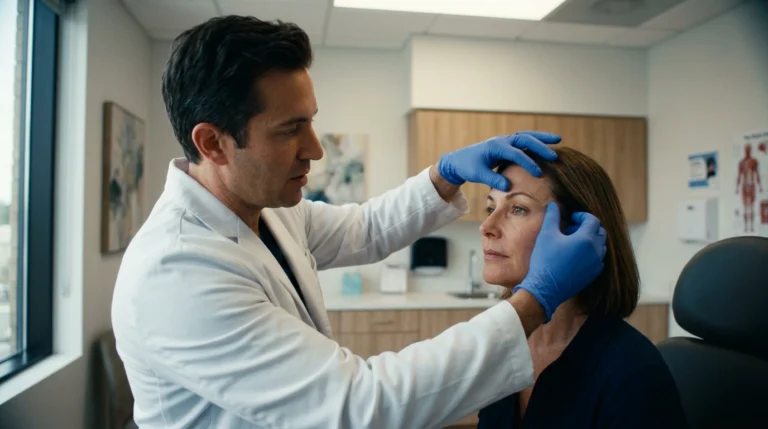
Brow lift or botox can improve a heavy brow through different mechanisms: Botox temporarily adjusts muscle pull, while surgery repositions brow and forehead tissues. Botox may suit a subtle dynamic change, whereas the degree and durability of a surgical lift vary with anatomy, skin laxity and the source of upper-eye heaviness. A clinical examination distinguishes brow descent from excess eyelid skin and related facial features.
Related treatment: Brow Lift →
- Botox can create a subtle, temporary brow lift effect by selectively reducing muscles that pull the brow downward.
- A surgical brow lift is designed to reposition brow and forehead tissues, so its potential effect is structurally different from Botox.
- The visible change from either option depends on brow shape, facial muscle activity, skin laxity and upper eyelid anatomy.
- Hooded eyes can result from a low brow, excess upper eyelid skin, or a combination of both.
- Brow lift, upper blepharoplasty and facelift address different anatomical areas, even when they are discussed for facial ageing changes.
Brow lift or botox refers to two different approaches to a low-sitting eyebrow: brow lift is a surgical procedure that repositions the brow and forehead tissues, while botulinum toxin is a temporary injectable treatment that relaxes the muscles pulling the brow downward. How much each can raise a heavy brow varies from person to person, because brow position reflects muscle balance, skin quality and individual facial proportions. The starting point is usually an assessment of the facial rejuvenation options suited to that anatomy.
Brow Lift or Botox for a Heavy Brow?
Brow lift surgery and botulinum toxin can both influence the appearance of a heavy brow, but they work through different mechanisms. Surgery repositions brow and forehead tissues, while injections act on the muscles that pull the brow downward. Because the mechanisms differ, the degree and durability of the change can also differ.
A heavy brow is rarely explained by brow height alone. The thickness and mobility of the forehead skin, the natural shape and arch of the eyebrow, the amount of upper eyelid skin and the proportions between brow, lid and orbital rim all contribute to how the upper face reads. Two people with similar brow measurements may look quite different because of these surrounding factors.
Botulinum toxin reduces the activity of selected muscles, which can allow the brow to settle slightly higher for a limited period. The effect is temporary and modest in scale. Surgical brow lifting aims to reposition tissue more structurally, which is a different order of change. Neither approach comes with a promised number of millimetres; visible improvement depends on anatomy, muscle strength, skin laxity and the starting position of the brow. For this reason, the brow is usually assessed alongside the rest of the upper face rather than in isolation.
Can Botox Create a Brow Lift?
Botulinum toxin can produce a non-surgical brow lifting effect in some people, although it does not match the scope of surgical repositioning. The change tends to be subtle and reversible as the effect wears off.
What is popularly called a “Botox brow lift” relies on altering the balance between opposing muscles. Several muscles pull the brow downward, while the frontalis muscle of the forehead raises it. When selected depressor muscles are relaxed, the elevating action may become relatively more dominant, and the brow can appear a little higher. The outer portion of the brow often shows this most clearly, though the central brow height, the amount of upper eyelid tissue and any pre-existing asymmetry can change the outcome considerably.
Because the result depends on which muscles are treated and how strongly they act, botulinum toxin treatment requires assessment of facial movement before anything is injected. Self-administered injections or generic template maps are not appropriate, since they ignore the individual pattern of muscle activity that determines how the brow responds.
How Much Can Botox Lift a Heavy Brow?
The amount of lift achieved with botulinum toxin is not the same for everyone, and no reliable universal figure in millimetres can be given. The response is individual.
Several factors influence it: the degree of existing brow descent, how actively the forehead muscle already works to hold the brow up, skin laxity, the shape of the brow and the differences between the two sides of the face. A brow that is low mainly because of strong downward muscle pull may respond differently from one that is low because of tissue descent.
Photographic comparisons can be misleading. Head position, whether the brow is contracted or relaxed, lighting and make-up all alter how the brow appears in an image. Assessment is more meaningful when the brow is observed both at rest and during facial movement. In general, injections may be considered for mild, movement-related downward pull, whereas more pronounced tissue descent or a significant excess of upper eyelid skin may not be adequately addressed by injections alone.
How Much Can Brow Lift Surgery Raise the Brows?
Brow lift surgery determines the amount and direction of elevation during surgical planning, based on the individual’s facial anatomy rather than on a standard target height. What suits one forehead may look unnatural on another.

The aim of surgical brow repositioning is not to raise the brows as far as possible. Planning considers the natural curve of the eyebrow, the proportions between brow, eyelid and orbital rim, and the position that preserves a relaxed, familiar expression. An over-elevated brow can look surprised or stiff, which is why restraint is part of the planning rather than a compromise.
Compared with injections, surgery aims at a more structural and longer-lasting change, because tissue position itself is altered rather than muscle activity alone. That does not mean every person obtains the same appearance, nor that perfect symmetry can be expected; eyebrows are rarely identical before surgery and may remain slightly different afterwards.
Examination typically looks at the hairline, the length and shape of the forehead, how mobile the skin is, the degree of asymmetry between the two brows, and the amount and quality of upper eyelid tissue. These findings together influence which approach, if any, is considered suitable.
Brow Lift Botox Placement Around the Forehead
Botulinum toxin placement for brow elevation is not applied to the same points in every person. The plan follows the individual pattern of muscle activity rather than a fixed diagram.
Muscles in the forehead, between the brows and around the eyes exert different forces on brow position, and their relative strength varies. For this reason, planning is better understood as an assessment of movement than as a muscle map that can be copied from one face to another.
In some people the frontalis muscle works hard to support a brow that would otherwise sit low. If that muscle is weakened inappropriately, the result can be a heavier-looking brow and upper eye region rather than a lighter one. This is a recognised reason for careful evaluation before treatment, and it is also why descriptions of injection technique are not a substitute for clinical examination.
Why Brow Lift Botox Injection Points Matter
The choice of injection points can influence the central brow, the outer brow and the balance of tissue around the eyelid in different ways. Small differences in placement may change how the brow sits.
Eyebrows are often naturally unequal in height, and muscle activity on the two sides of the face may differ. A plan that ignores this can accentuate an existing asymmetry instead of softening it.
Injection points are also not assessed only for their lifting potential. Forehead lines, movement between the brows, how widely the eyes open and the preservation of normal expression all influence planning, and these aims sometimes pull in different directions. Temporary brow or eyelid asymmetry and an altered expression are among the possible unwanted effects, which is why individual assessment and careful technique matter. Risks vary from person to person and are discussed before any treatment.
Brow Lift or Upper Blepharoplasty for Hooded Eyes?
With hooded eyes, the decision depends on whether the appearance comes mainly from a low brow position, from excess upper eyelid skin, or from a combination of both. The same outward look can have different underlying causes.
Upper blepharoplasty, or upper eyelid surgery, addresses the skin and tissue of the eyelid itself. Brow lifting addresses the position of the brow and forehead. Removing eyelid skin when the main issue is a descended brow may not produce the expected result, and raising the brow when there is a marked excess of lid skin may leave the heaviness partly unchanged.
Both findings often coexist, particularly in the upper outer region, and in suitable cases the two may be considered together. A careful hooded eyelid assessment distinguishes between these contributions by examining brow height, lid skin and the relationship between them, which becomes clear only in person rather than from photographs.
Brow Lift or Eyelid Surgery?
The choice between brow lifting and eyelid surgery follows the anatomical source of the visible heaviness. Identifying that source is the central part of the assessment.
Several points are usually examined: the position of the brow in relation to the upper orbital rim, the amount of upper eyelid skin, the shadowing along the lash line, and how much a person uses the forehead muscle to hold the brows up during the day. People who raise their brows constantly may look very different when the forehead is fully relaxed.
Loose eyelid skin can sometimes make a brow appear lower than it is, so the eyelid dominates the impression. Conversely, excess lid tissue may continue to create a sense of weight even after the brow has been repositioned. Because these patterns overlap, the decision is made through a plastic surgery examination rather than from a description of symptoms alone.
Brow Lift or Forehead Lift?
The terms brow lift and forehead lift frequently overlap in clinical use, because both may address closely connected tissues of the forehead and brow region. The words are often used interchangeably in everyday conversation.
They do not always refer to the same incision, technique or direction of elevation. The plan may differ according to hairline position, forehead length and shape, whether descent is more marked at the inner or outer brow, and how much skin laxity is present.
Rather than focusing on the name of the operation, it is generally more useful to ask which anatomical area is being addressed and what change is intended, since that is what determines the result.
Brow Lift or Face Lift?
Brow lifting targets the upper face and brow region, while a face lift mostly addresses the mid-face, lower face and jawline. The two procedures have different anatomical territories.
A face lift alone may not meaningfully change a heavy brow or the appearance of the upper eye area, because facial ageing does not progress at the same rate in every zone. Some people notice changes around the eyes well before the jawline alters, and others the opposite.
Brow, eyelid, mid-face and neck changes can be assessed together as part of one overall picture, while each procedure still has its own distinct target. Suitability is determined through examination and facial analysis carried out by Prof. Dr. Şükrü Yazar.
Frequently Asked Questions
Can Botox replace a brow lift?
Botox may create a subtle temporary lift in selected cases by changing muscle pull around the brow. It may not provide the same degree or durability of repositioning as brow lift surgery when tissue descent or skin laxity is more prominent.
Does Botox lift the whole eyebrow?
Botox can affect different parts of the eyebrow differently. The outer brow may respond more visibly in some faces, while the central brow and upper eyelid appearance depend on individual muscle activity and anatomy.
Can Botox make hooded eyes look worse?
An unsuitable muscle balance or dose placement can contribute to a heavier-looking brow or eyelid in some people. This is one reason facial movement and baseline brow position need assessment before treatment.
Is a brow lift the same as a forehead lift?
The terms may overlap because brow position and forehead tissues are closely connected. The exact approach and intended correction can differ according to the anatomy being addressed.
Can brow lift and eyelid surgery be considered together?
They may be considered together when both low brow position and excess upper eyelid tissue contribute to the appearance. Whether either or both are appropriate depends on a clinical examination.