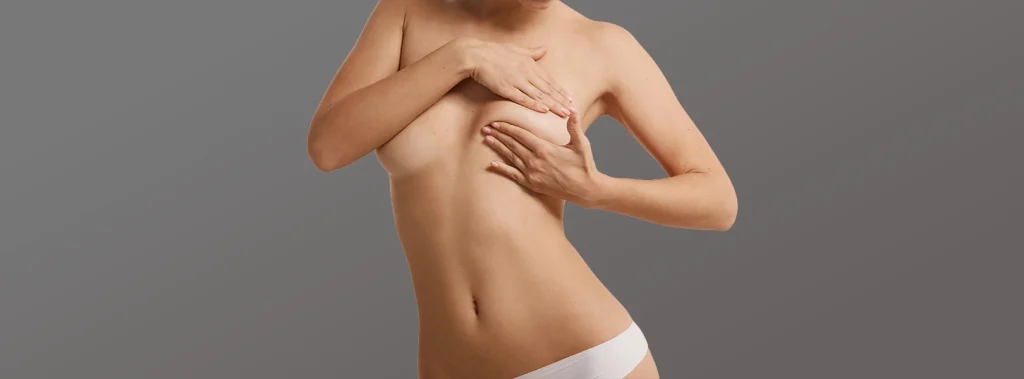
Tuberous (tubular) breasts did not develop fully at puberty: the base is narrow, the fold sits high and the areola is puffy. Surgery releases the tight base, lowers the fold, reduces the areola and adds volume with an implant or fat when needed. Most people return to desk work within a week.
- Tuberous and tubular breasts are the same developmental condition: a narrow base, a high fold and a puffy areola.
- The condition is harmless but does not improve with time, weight gain or exercise.
- Correction releases the tight base, lowers the fold, reshapes the tissue and reduces the areola.
- Volume is added with an implant, fat transfer or both, depending on the grade.
- A stay of five to seven days in Istanbul is usually enough; the final shape appears over three to six months.
Tuberous breasts, also called tubular breasts, are breasts that did not develop to their full shape during puberty. The base of the breast is narrow, the fold beneath it sits high and tight, and the areola is often large and puffy because breast tissue pushes forward into it. One or both breasts can be affected, and the difference between the two sides is often what people notice first. The condition is harmless, but it can affect confidence, the way clothes and swimwear fit and how comfortable someone feels in intimate situations. Surgery can release the tight base, reshape the breast and, when needed, add volume.
What Tuberous Breasts Look Like
No two tuberous breasts look exactly alike, but most share several of these features:
- a narrow base, so the breast looks tall and pointed rather than round;
- a fold beneath the breast that sits higher than usual, leaving little skin between the nipple and the fold;
- a lower half that is flat or missing, sometimes only on the inner or outer side;
- a large, domed areola where breast tissue bulges forward;
- a wide gap between the breasts;
- a smaller breast volume, often with a visible difference in size or shape between the two sides.
Mild forms can be hard to recognise, and many people simply describe their breasts as small, droopy or uneven before the condition is identified at consultation. A closer look at how the signs and grades are recognised can help in understanding the features before the first appointment.
Why the Breast Develops This Way
The breast begins to grow at puberty from the area behind the nipple. In tuberous breasts, a tight band of fibrous tissue at the base of the breast holds this growth back, especially in the lower half. Unable to expand downwards and outwards, the breast tissue grows forward instead, pushing into the areola and stretching it. The exact cause of the band is not known. It is not caused by anything a person did, and it does not improve with time, weight gain or exercise.
Grades: From a Tight Lower Pole to a Fully Constricted Breast
Surgeons grade tuberous breasts to decide how much correction is needed. A simple way to describe the grades is:
- Grade 1: only the lower inner part of the breast is underdeveloped; the breast looks slightly tilted outwards.
- Grade 2: both lower quarters are underdeveloped, but there is enough skin beneath the areola.
- Grade 3: both lower quarters are underdeveloped and the skin beneath the areola is short and tight.
- Grade 4: the whole base of the breast is constricted, and the breast is small and tubular in shape.
Lower grades can often be corrected with tissue reshaping and a modest amount of added volume. Higher grades need a more extensive release of the base, a lower fold and, in most cases, an implant.
How Tuberous Breast Correction Works
Correction is planned individually, but most operations combine the same steps, usually through an incision around the edge of the areola:
- Releasing the tight base: the fibrous band is divided from inside the breast so that the tissue can spread out.
- Lowering the fold: the fold beneath the breast is moved down to a natural level, creating space for a fuller lower half.
- Reshaping the breast tissue: the released tissue is unfolded and redistributed to fill the flat lower part of the breast.
- Correcting the areola: the areola is reduced and the bulging tissue is set back, so that the nipple area sits flat and in proportion.
- Adding volume when needed: with an implant, fat transfer or both.
The operation takes about two to three hours under general anaesthesia, and most people stay in hospital for one night.
Implant, Fat Transfer or Both
When the breast is also small, a breast implant provides volume and helps stretch the tight lower half into a rounder shape. The implant is chosen by the width of the chest and the breast base rather than by volume alone, and it is often placed partly beneath the chest muscle to give soft coverage in the upper breast.
Fat injection uses fat taken by liposuction from the abdomen or thighs. It suits milder forms, smooths the edges of the corrected shape and can fill the lower half without an implant, though part of the fat is reabsorbed and a second session is sometimes needed. In some cases combining an implant with fat transfer gives the most natural result: the implant provides the main volume, and fat softens the transition around it. The trade-offs of fat transfer to the breasts are worth understanding before choosing.
When Only One Breast Is Affected
Tuberous breasts are often uneven. One breast may be affected while the other developed normally, or both may be affected to different degrees. In these cases each breast is planned separately: the tuberous side may need release, a lower fold and an implant, while the other side may need only a smaller implant, a lift or no surgery at all. The approach to breast asymmetry follows the same principle of matching the two sides in shape, size and nipple position, and it helps to know how much difference between the breasts is normal.
The Puffy Areola and How It Is Reduced
A large, domed areola is one of the most typical signs. During correction, the areola is reduced to a size that suits the new breast, and the tissue that bulged into it is pushed back and supported from inside. A permanent stitch around the areola helps to stop it from stretching again. The same principles are used in nipple aesthetics, including reducing a large areola while keeping sensation.
The Consultation: Measurements and Planning
At consultation, the width of the breast base, the position of the fold, the distance between the nipple and the fold, the size of the areola and the quality of the skin are measured on both sides. These measurements decide how far the fold needs to be lowered, whether an implant is needed and what size it should be, and whether the nipples also need to be raised with a breast lift. Photographs are taken for planning. People travelling from abroad can send photographs in advance for a preliminary assessment.

Age and Timing
Correction is usually planned once the breasts have stopped growing, which is generally from the late teens onwards. Operating earlier risks a result that changes as the breasts continue to develop. Pregnancy and breastfeeding change the breasts, so some people choose to wait until after having children. Others prefer correction earlier because of its impact on confidence; a later pregnancy may change the shape, and a lift may then be considered.
Where the Scars Lie and How They Fade
In most cases the only scar runs around the edge of the areola, where the colour change helps to hide it. If an implant is placed through the fold, there is also a short scar in the crease beneath the breast. If a lift is needed, a vertical scar may run down from the areola. Scars are pink at first and fade over twelve to eighteen months. Fat transfer leaves only tiny marks where the fat was taken and injected.
Recovery: The First Six Weeks
Discomfort and tightness are expected in the first days and are managed with pain relief. A supportive surgical bra is worn day and night for about six weeks. Most people return to desk work within a week, avoid lifting heavy objects and raising the arms above the shoulders for two to three weeks, and return to sport after about six weeks. Swelling settles over the first months; the breasts look high and firm at first, and the final shape appears gradually as implants soften and settle, usually over three to six months.
Breastfeeding After Correction
Tuberous breasts can contain less milk-producing tissue, so some people find breastfeeding difficult even without surgery. Correction around the areola can affect some milk ducts and nerves, although many people are able to breastfeed afterwards. Because the outcome cannot be predicted with certainty, plans for future breastfeeding should be discussed at consultation, as they can influence the choice of technique.
Risks Specific to Tuberous Breast Surgery
Alongside the general risks of breast surgery, such as bleeding, infection and changes in nipple sensation, tuberous breast correction carries some specific risks:
- the lower half can stay narrow if the band was not fully released;
- a crease across the lower breast (double-bubble) can show if the old fold remains visible;
- the areola can stretch again over time;
- some difference between the two sides can remain, because the breasts started from different points;
- implant-related risks, such as capsular contracture or a change in position;
- partial reabsorption of transferred fat.
Because tuberous breasts are among the more complex breast operations, a small revision is sometimes needed to fine-tune the result. Thorough planning and complete release of the base during the first operation reduce this need.
How the Corrected Shape Holds Up Over the Years
Once the tight base has been released and the breast reshaped, the constriction does not return on its own, so the correction itself is long-lasting. The breasts continue to change with age, weight changes and pregnancy, like any breasts. Implants are not lifetime devices; many last for well over a decade, but they may need to be replaced or adjusted at some point. Transferred fat that survives the first months behaves like the body’s own fat and stays, changing only with weight. Keeping a stable weight and wearing a supportive bra during sport help to preserve the shape.
Tuberous Breast Correction in Istanbul: Planning Your Stay
Many people travel to Turkey for tuberous breast correction. A stay of five to seven days is usually enough: an in-person consultation and measurements before surgery, the operation with one night in hospital, and a check of the wounds before the flight home. On the flight, the surgical bra is worn, and walking in the aisle and drinking water help circulation. Follow-up can continue by video call and with photographs during the first months.
Tuberous Breasts Frequently Asked Questions
Is there a difference between tuberous and tubular breasts?
The two names describe the same developmental condition and are used interchangeably. Some surgeons use “tubular” for the elongated, tube-like shape and “tuberous” for the constricted base with a bulging areola, but the cause and the principles of correction are the same.
Can tuberous breasts be corrected without an implant?
Yes, when the breast has enough volume and the main problems are the tight base, the high fold and the puffy areola. Releasing the base, reshaping the breast tissue and reducing the areola can be enough, and fat transfer can add a little fullness. When the breast is also small, an implant usually gives the more reliable result.
Will the result look natural?
The aim is a rounder lower half, a fold at the right level and an areola in proportion to the breast. Because the breast tissue itself is reshaped rather than simply enlarged, the result usually looks natural, although the final shape takes several months to settle.
Can the constriction come back after surgery?
If the tight band at the base is not fully released, the lower half can stay narrow or a crease can show across the breast, sometimes called a double-bubble. Careful release and reshaping during the first operation keep this risk low, and a small revision can correct it if it happens.
Is the condition harmful to health?
No. Tuberous breasts are a difference in how the breast develops, not a disease, and correction is chosen for appearance, comfort and confidence. Normal breast checks and screening should continue after surgery.
How long should I stay in Istanbul after surgery?
Most people plan a stay of five to seven days, which allows for the consultation, the operation and a check of the wounds before flying home.
References
- Review of tuberous breast deformity: developments over the last 20 years — Plastic and Reconstructive Surgery Global Open (2022)
- A systematic review of outcomes and complications of tuberous breast surgery — Aesthetic Surgery Journal (2023)
- Correction of the tuberous breast with fat grafting and implant — Aesthetic Plastic Surgery (2024)
- Breast augmentation — British Association of Aesthetic Plastic Surgeons
Professor Şükrü Yazar, Consultant Plastic, Reconstructive and Aesthetic Surgeon, sees patients for tuberous breast correction and other breast surgery consultations at his practice in Nişantaşı, Istanbul.
The information here is for guidance only and does not replace examination, diagnosis or treatment.