
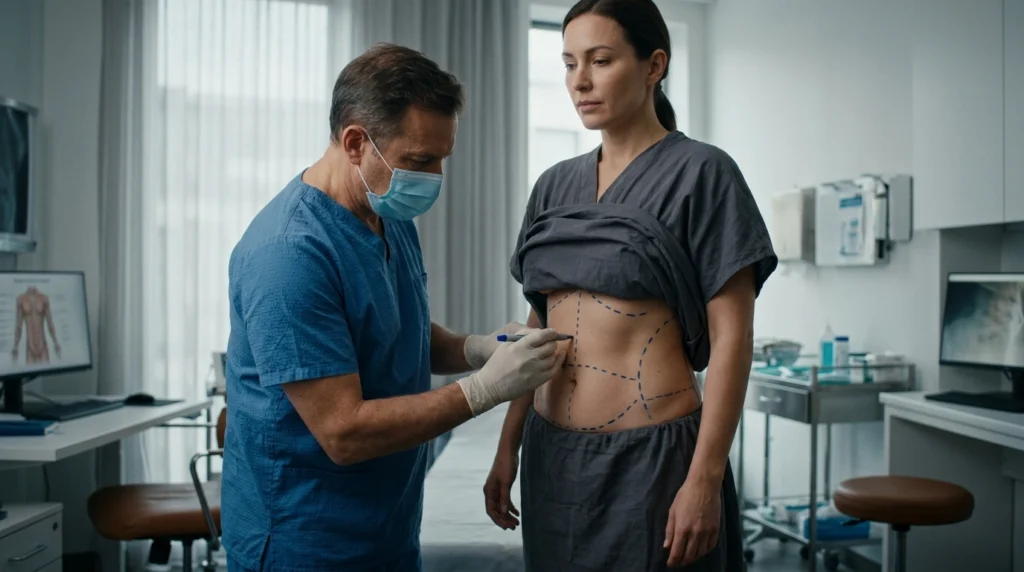
360 liposuction usually treats the abdomen, waist, flanks and selected back areas as one connected torso contour. Lipo 360 may include the outer hips in some plans, while the buttocks, arms, thighs and other body regions are generally assessed separately. The final treatment map is determined during surgical examination.
- 360 Liposuction is a circumferential torso-contouring approach that commonly considers the abdomen, waist, flanks and back together.
- The term Lipo 360 does not mean that every area around the body, or every part of the torso, will be treated.
- Flank and back treatment may be relevant because these areas influence the transition from the abdomen to the waist and lower back.
- Outer hip fat may be included in selected treatment plans, but liposuction does not change pelvic bone structure or guarantee correction of hip dips.
- A tummy tuck and 360 Liposuction address different anatomical concerns and may be considered together only after individual assessment.
360 liposuction, often shortened to Lipo 360, is a contouring approach that treats the midsection as a single circumferential unit rather than one isolated site. Planning covers the front, sides and back of the torso together, and it sits alongside other body contouring options that address different concerns.
What Does 360 Liposuction Mean?
360 Liposuction, also called Lipo 360, describes liposuction planned around the circumference of the torso rather than on the front of the abdomen alone. The term refers to the planning logic rather than to a specific device or a patented technique. Instead of reducing fat in one visible spot and leaving the adjacent regions untouched, the surgeon assesses how the front, side and back views relate to one another.
The number in the name can be misleading. It does not imply that every square centimetre around the body is treated, nor does it mean a fixed set of zones applies to everyone. In practice, the regions most often considered together are the abdomen, the waist, the flanks and parts of the back. These areas sit next to each other anatomically, so fullness in one can influence how the others look in clothing or in profile.
Because the concept is descriptive rather than standardised, the meaning of Lipo 360 can differ slightly between clinics. What stays constant is the principle: connected torso regions are evaluated as one contour. The technical steps of the operation itself, including anaesthesia and the method of fat removal, are a separate discussion and depend on the individual plan.
Which Body Areas Does 360 Liposuction Cover?
360 liposuction most commonly addresses the abdomen, the waist, the flanks and portions of the back as one continuous torso contour. These regions are chosen because they form a connected band around the trunk, and treating only part of that band can leave a transition that remains visible from the side or from behind.
The exact 360 Liposuction Areas included in a plan are not decided in advance from a template. They are selected after an assessment of fat distribution, skin quality and elasticity, the existing shape of the waist, previous surgery or pregnancies, and the balance a person hopes to see between the front, side and back views. Someone with marked fullness across the lower back may need a different map of treated zones than someone whose main concern is the upper abdomen.
It is also worth separating this from weight management. Liposuction removes localised fat deposits; it is not a weight-loss method, and it does not treat the metabolic or health consequences of excess body weight. People at a stable weight with reasonably good skin tone tend to be the ones for whom contouring is discussed, although this is an individual judgement.
Planning for the liposuction procedure is therefore personal, and only a surgeon’s physical examination can determine whether a particular area is suitable for treatment, whether it should be reduced conservatively, or whether a different approach would address the concern more appropriately.
The Abdomen in Lipo 360 Treatment Areas
The abdomen is almost always part of the plan because it forms the front portion of the circumferential contour, and the result there sets the reference point for the sides and back. Upper and lower abdominal fullness are usually assessed separately, then considered in relation to the waist and the adjacent flanks rather than in isolation.

There are clear limits to what fat removal achieves in this region. Liposuction can reduce localised fat, but it does not tighten significant loose skin and it does not repair separation of the abdominal muscles. Where skin laxity, pregnancy-related changes or muscle separation are the dominant finding, reducing the fat layer alone may not deliver the contour a person has in mind, and the conversation shifts towards other surgical options. This distinction is one of the main reasons an examination precedes any decision about the abdominal component of Lipo 360 Treatment Areas.
Why Are the Flanks Often Included?
The flanks, commonly called love handles, are frequently included because they connect the abdomen to the back and have a strong influence on how the waistline appears. Leaving them untreated while reducing the abdomen can create a step between the front and the side view.
Flank fullness often persists despite stable eating and activity habits, since fat distribution is shaped considerably by anatomy, hormonal factors and genetics rather than by effort alone. Reducing fullness in this area may make the transition from ribcage to hip look smoother, though the visible outcome depends on the surrounding abdomen and back, on skin quality, and on the underlying skeletal frame. No single result pattern applies to everyone.
How Much of the Back Can Lipo 360 Address?
Lipo 360 may include selected upper, mid or lower back areas when fullness there interrupts the intended torso contouring across the abdomen, waist and back. The back is rarely treated in its entirety; instead, specific zones are mapped according to where fat sits.
These zones behave differently. Bra-line fullness, which shows as a roll beneath a garment strap, is a distinct pattern from side-back fullness continuing on from the flanks, and both differ from lower-back fullness above the waistband. A plan may include one of these, two, or all three, depending on the examination. Treating one pattern does not automatically address another.
The reason a circumferential approach is considered at all becomes clearer here. The lower back and the flanks are continuous tissue; the waist line that a person sees in the mirror is produced by the relationship between the two. Reducing the flanks without assessing the back, or the reverse, can leave an uneven transition when viewed from behind. At the same time, skin on the back is thicker and less elastic in many people, which affects how much change is realistic and is one of the points discussed before treatment.
Can 360 Liposuction Treat the Hips?
The outer hip area may be included in some Lipo 360 plans, but it is not automatically part of every treatment. Inclusion depends on whether fullness at the upper outer hip continues the line of the flanks and lower back, or whether it sits separately and would be better considered on its own.
A distinction matters here. Reducing a localised fat pad at the upper outer hip changes the soft tissue layer only. The width and shape of the pelvis itself are skeletal and cannot be altered by liposuction. For people whose frame is naturally broader at the hips, soft tissue reduction produces a more modest change than they may expect.
The visible indentation sometimes called hip dips is another example. That contour is shaped partly by bone structure, partly by the position and bulk of the gluteal and surrounding muscles, and only partly by fat distribution. Removing fat nearby may soften the appearance in some cases, and in others it may make the indentation more noticeable. This is assessed individually rather than assumed.
Are the Buttocks Included in Lipo 360?
The buttocks themselves are not automatically treated as part of Lipo 360, although the surrounding lower back and upper hip contour are often relevant to the overall plan because they frame the area visually. Whether anything is done close to the buttock region depends entirely on the examination findings.
Removing fat near the buttocks and adding volume to the buttocks are different clinical decisions with different aims, different techniques and different planning considerations. They are not interchangeable, and one does not substitute for the other. Conservative judgement also matters: taking too much fat from the upper buttock or lower back can flatten the junction between the two and unbalance the contour, which is difficult to correct afterwards. Where the concern follows pregnancy, the discussion may instead involve post-pregnancy body contouring, since skin changes and abdominal wall laxity are often part of the picture.
Which Areas Are Not Usually Part of Lipo 360?
The arms, thighs, calves, face, neck and other body regions are generally treated as separate areas rather than routine components of Lipo 360. They are not connected to the torso band that the term describes, and including them changes the scale and planning of the operation.
For this reason, the term should not be read as whole-body liposuction. It is a torso-focused concept with defined boundaries. A surgeon may discuss adding another region only after weighing the overall surgical plan, the total volume involved, the duration of anaesthesia and whether combined treatment is appropriate for that person. In many cases, staging the areas across separate sessions is the more sensible option.
Can 360 Liposuction Be Combined with a Tummy Tuck?
360 Liposuction and abdominoplasty, commonly called a tummy tuck, can be considered together in selected cases, although they address different problems. One reduces fat and refines the torso outline; the other deals with the skin envelope and, where relevant, the abdominal wall.
Lipo 360 primarily targets localised fat deposits and the circumferential contour of the trunk. A tummy tuck may remove excess abdominal skin and, where appropriate, tighten laxity in the abdominal wall following pregnancy or significant weight change. When both findings are present, treating only one can leave the other concern unchanged, which is why combination is sometimes raised.
Combining is not automatic, however. The decision rests on examination findings, medical history, skin quality, the amount of tissue involved and the surgeon’s assessment of what can be carried out safely in a single operation. In some cases the procedures are staged rather than combined. The choice of procedures and their sequencing is established during a medical consultation, where the individual plan is explained in full.
Suitability for any of these options, and the specific areas to be treated, is determined by examination and assessment carried out by Prof. Dr. Şükrü Yazar.
Frequently Asked Questions
What areas are included in 360 liposuction?
360 liposuction commonly includes the abdomen, waist, flanks and selected back areas. The exact zones vary, because body shape, fat distribution and skin quality differ from person to person.
Does Lipo 360 include the hips?
The outer hip area can be included when it contributes to the planned torso contour, but it is not a standard inclusion in every Lipo 360 procedure. Liposuction does not change the underlying width or structure of the pelvis.
Does Lipo 360 include the buttocks?
Lipo 360 does not automatically include the buttocks. The lower back and upper hip region may be assessed around the buttocks, while buttock volume and projection require separate planning.
Can Lipo 360 be combined with a tummy tuck?
Lipo 360 may be combined with a tummy tuck in suitable cases, when both localised fat and loose abdominal skin or abdominal wall laxity need consideration. A surgical examination determines whether combination treatment is appropriate.
Why do 360 liposuction results vary between patients?
Outcomes differ because anatomy, skin elasticity, fat distribution, skeletal frame and the treated areas are not the same for everyone. A consultation is more useful than general expectations for understanding which areas may be treated in a particular case.
We cover 360 lipo results in a separate article.

