Smart Lipo is laser-assisted liposuction: a thin laser fibre loosens stubborn, localised fat and gently heats the tissue, and the fat is either cleared by the body or removed with a fine cannula. It is done under local anaesthesia, takes about 45 minutes per area and suits people close to a stable weight, not weight loss.
- Smart Lipo is laser-assisted liposuction for localised fat deposits that do not respond to diet and exercise; it is not a weight-loss treatment.
- The laser can be used alone for small, delicate areas such as the jowls, or followed by gentle suction when more fat needs to be removed.
- Limited areas are treated under local anaesthesia in about 45 minutes, and most people go home the same day.
- Heat from the laser can improve mild skin laxity, but it cannot remove excess skin; a tummy tuck or arm lift is needed for that.
- The final contour is judged at around two months; possible risks include swelling, numbness, irregularities and, specific to lasers, skin burns.
Smart Lipo (often written SmartLipo) is laser-assisted liposuction: a thin laser fibre is passed beneath the skin to break down fat and gently heat the tissue before, or instead of, removing the fat with a fine cannula. It is designed for stubborn, well-defined pockets of fat in people who are close to their target weight, not for weight loss. Professor Şükrü Yazar performs it under local anaesthesia; a typical area takes around 45 minutes and most people go home the same day.
What Is Smart Lipo?
Smartlipo is the brand name of a laser platform made for laser-assisted liposuction, and it was among the first laser systems cleared by the US Food and Drug Administration for laser lipolysis. Because the brand became so well known, “smart lipo” is now widely used for laser liposuction in general. The medical term for the technique is laser-assisted liposuction (LAL).
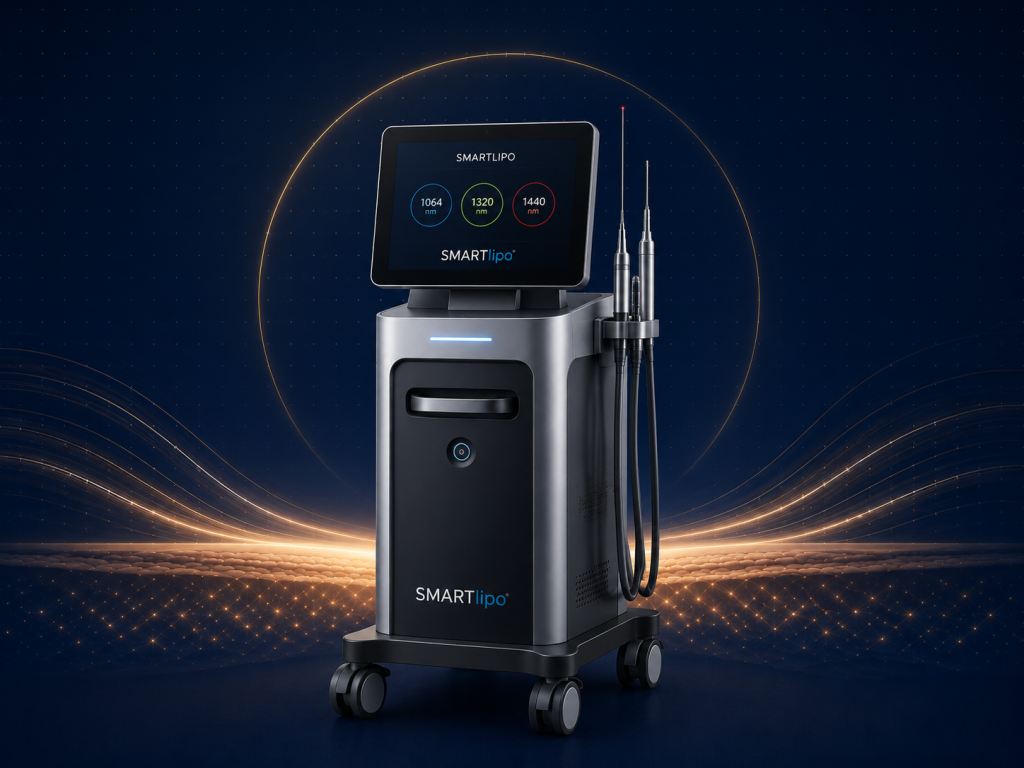
The current generation, Smartlipo Triplex, combines three wavelengths in one device (1064, 1320 and 1440 nm). Each wavelength interacts with fat and the surrounding tissue slightly differently, so the surgeon can adjust how the energy is delivered for the area being treated: more emphasis on breaking down fat in one place, more on heating the layer under the skin in another.
A balanced diet and regular exercise remain the foundation of a healthy body shape. Some fat deposits, however, do not shrink in proportion to the rest of the body even with consistent effort: the lower abdomen, the flanks, the inner thighs, the upper arms and the area along the jawline are typical examples. Smart Lipo is aimed at these localised deposits. It changes the contour of a defined area; it does not change overall body weight in a meaningful way.
Laser Lipolysis and Laser Liposuction: Two Ways the Device Is Used
The same device can be used in two different ways, and which one is chosen depends on the size of the area and the amount of fat.
Laser lipolysis (laser alone)
The laser light travels through an optical fibre about one millimetre thick, placed in the fat layer through a tiny entry point. Short, high-energy pulses disrupt the membranes of the fat cells and release their contents. In small areas, the body clears this liquefied fat gradually through its normal lymphatic pathways, so no suction is needed. Laser lipolysis suits delicate, limited areas where only a small volume needs to change, such as the cheeks and the jowls along the jawline.
Laser liposuction (laser followed by gentle suction)
When there is more fat, the laser step is followed by low-pressure aspiration through a microcannula about three millimetres in diameter. The fat has already been loosened by the laser, so it can be removed with less mechanical force than in traditional liposuction. This approach is used when a larger volume needs to be removed and the person wants the change to show sooner, because the fat leaves the body on the day rather than being cleared over weeks.
Smart Lipo vs Traditional Liposuction and VASER
All liposuction techniques remove fat through small incisions with a cannula; what differs is how the fat is loosened first. In traditional (suction-assisted) liposuction, the surgeon loosens the fat by moving the cannula back and forth. In VASER, ultrasound energy emulsifies the fat. In Smart Lipo, laser energy does this job and at the same time heats the layer just under the skin.
| Smart Lipo (laser) | VASER (ultrasound) | Traditional liposuction | |
|---|---|---|---|
| How fat is loosened | Laser energy through a fine fibre | Ultrasound energy through a probe | Mechanical movement of the cannula |
| Typical use | Small to moderate, well-defined areas; face and neck; touch-ups | Moderate to larger areas; definition work | Small to large volumes, several areas at once |
| Usual anaesthesia | Local anaesthesia | Sedation or general anaesthesia for larger plans | Local, sedation or general, depending on extent |
| Skin effect | Some tightening from heat in selected patients | Some tightening from heat in selected patients | Relies on the skin’s own ability to contract |
| Specific consideration | Thermal injury if energy is not controlled | Thermal injury if energy is not controlled | Contour irregularity in thin skin |
None of these methods is superior for everyone. For several areas or a large volume, traditional or VASER liposuction is usually more practical; for one or two limited areas, or when the skin needs a little extra help, a laser-assisted approach may make sense. Lipomatik, a vibration-assisted device, is another option for larger volumes.
What the Research Shows About Skin Tightening
The main argument for using a laser rather than suction alone is the heat effect on the skin. The evidence supports this, but with caveats worth knowing.
- In a randomised, blinded split-abdomen study, areas treated with Smartlipo laser-assisted liposuction showed significantly more skin shrinkage than areas treated with suction alone at one and three months, and greater skin tightening at three months.
- A systematic review comparing laser-assisted with traditional liposuction found that most studies reported more fat reduction, better skin retraction and higher patient satisfaction with the laser, but judged the studies to carry a high risk of bias, so the size of the advantage is not certain.
- A series of 1,000 consecutive laser-assisted and suction-assisted procedures performed under local anaesthesia, in patients with a body mass index below 30, reported no major complications; the amount of fat removed was comparable to traditional liposuction, and 7.3% of procedures were followed by a touch-up.
In practical terms, the tightening is modest. It can help skin with mild laxity sit more neatly over the new contour, but it cannot remove a hanging fold of skin. When there is genuine excess skin, an excisional operation such as a tummy tuck or an arm lift is the honest answer, sometimes combined with liposuction.
Who Is a Good Candidate for Smart Lipo?
Smart Lipo tends to give the most satisfying results in adults who:
- are at or close to a stable, healthy weight, with a localised deposit that has not responded to diet and exercise;
- have skin with reasonable elasticity, or only mild laxity;
- want to refine one or two defined areas rather than reduce their overall size;
- are in good general health, with any high blood pressure, heart disease or diabetes brought under control before treatment;
- understand that the final shape appears gradually over about two months.
It is less suitable when the main problem is loose skin, a separated abdominal wall after pregnancy, widespread fat over several regions, or a condition such as lipedema, which needs a staged, specialised liposuction plan. Pregnancy, breastfeeding, active skin infection in the area and poorly controlled medical conditions are reasons to postpone. People who prefer to avoid any incision can look at non-surgical body contouring and local slimming treatments, which work more slowly and change less.
Which Areas Can Be Treated With Laser Liposuction?
Because the fibre and cannulas are fine, laser liposuction is useful in areas where precise, small changes matter:
- Face and neck: the jowls, the cheeks and the area under the jawline. Laser lipolysis is particularly suited to these delicate zones, where only small volumes are removed and nerves lie close to the surface.
- Upper arms: fat on the back of the arm with good skin quality. When skin hangs, an arm lift is usually needed rather than liposuction alone.
- Abdomen and flanks: lower-abdominal fat and the “love handles” above the hips, in people without significant loose skin.
- Back and bra line: rolls of fat along the bra strap and the lower back.
- Thighs and knees: inner thighs, outer thighs and the fat pad on the inner side of the knee.
- Male chest: fatty enlargement of the male chest, when glandular tissue is not the main component; the overview of gynecomastia in men explains the difference.
- Touch-ups after previous liposuction: small, residual pockets or uneven areas left by an earlier operation can sometimes be refined with the fine laser instruments, after an examination of the scar tissue and the remaining fat.

How the Smart Lipo Procedure Is Performed
At the consultation, the areas of concern, skin quality, medical history and medicines are reviewed, and alternatives are discussed. Medicines and supplements that increase bleeding may need to be paused beforehand, on the surgeon’s advice.
On the day of treatment, the areas are marked with the patient standing, so that the natural contour is visible. The skin is cleaned and a tumescent solution containing a local anaesthetic and a medicine that narrows the blood vessels is infiltrated into the fat layer. This numbs the area and reduces bleeding, so general anaesthesia is not usually required for limited areas. The patient stays awake and comfortable, and may feel pressure, movement or warmth rather than sharp pain.
The laser fibre is introduced through entry points of a few millimetres and moved continuously in a fan-shaped pattern through the fat, while the energy delivered is monitored to protect the skin. Where removal is planned, the loosened fat is then aspirated through the microcannula. The entry points are small enough that they usually need only a small dressing or a single stitch. The whole procedure takes an average of about 45 minutes for one area; treating several areas takes longer.
Smart Lipo Recovery and When Results Show
Recovery after laser liposuction of a limited area is usually short:
- The same day: most people walk out of the clinic and go home or to their hotel. Some fluid may seep from the entry points during the first 24–48 hours; this is the tumescent solution and is expected.
- The first days: many people return to desk work and normal daily routines within one to three days. Mild swelling, tenderness and some bruising are common, although usually less than after traditional liposuction of a similar area.
- Compression: after laser lipolysis of a small area a garment is often unnecessary; when fat has been aspirated, a light compression garment for a few weeks may be advised to control swelling.
- Exercise: walking is encouraged from the first day; gym work and heavier activity usually resume after one to two weeks, depending on the area.
- Results: part of the change is visible soon after treatment, especially when fat was aspirated. The remaining slimming and any skin tightening develop gradually, and the result is assessed at around two months, once the swelling has settled and the tissue has contracted.
Increasing rather than easing pain, spreading redness or warmth, fever, a hard swelling on one side, or calf pain and breathlessness should be reported to the clinic straight away.
Possible Risks of Laser Liposuction
Smart Lipo is a minimally invasive surgical procedure, and like any procedure it has possible side effects. Most are temporary:
- swelling, bruising and tenderness in the treated area;
- numbness or altered sensation of the skin, which usually returns over weeks to months;
- small surface irregularities or slight asymmetry, sometimes requiring a touch-up;
- a collection of fluid (seroma) or blood (haematoma) under the skin;
- infection at an entry point, usually treated with antibiotics;
- thermal injury (a burn) to the skin, the risk specific to energy-based devices.
The burn risk depends on technique: continuous movement of the fibre, control of the total energy delivered and temperature awareness near the skin. In the 1,000-procedure series cited below, the three burns occurred during the first 25 cases, which the authors linked to the learning curve. Matching the method to the problem matters just as much: when the main concern is loose skin or a large volume of fat, laser lipolysis alone is not the right tool, and traditional liposuction or an excisional operation is planned instead.
Is the Fat Gone for Good?
Fat cells destroyed or removed from the treated area do not grow back. The remaining fat cells in that area, and fat cells elsewhere in the body, can still enlarge if weight increases, so a large weight gain can soften the result or shift fat to untreated areas. People who keep their weight stable generally keep their new contour. Ageing and hormonal changes will still affect the body over time.
Smart Lipo in Istanbul: Planning a Short Stay
Professor Şükrü Yazar performs laser-assisted liposuction at his practice in Nişantaşı, Istanbul. Because most limited treatments are done under local anaesthesia with a same-day discharge, visitors from abroad usually need only a short stay: the consultation, the procedure and a check of the entry points within a few days are generally enough before flying home. Longer flights soon after any body procedure carry a small risk of blood clots, so walking regularly, staying well hydrated and following the advice given at discharge are important. When Smart Lipo is combined with other operations, for example as part of a mommy makeover, the plan, anaesthesia and length of stay change accordingly.
Frequently Asked Questions
Is Smart Lipo painful?
The treatment area is numbed with local anaesthesia, so most people feel pressure, movement or warmth rather than pain during the procedure. Soreness similar to a pulled muscle is common for a few days afterwards and is usually managed with simple pain relief.
How many sessions are needed?
Usually one. Unlike non-surgical fat reduction, which typically needs several sessions, laser liposuction treats the area in a single procedure. A small touch-up is occasionally needed once the final result has settled.
Is Smart Lipo better than VASER?
Neither is better in every case. Both use energy to loosen fat and can support some skin contraction. Laser-assisted liposuction is often preferred for small, delicate or well-defined areas under local anaesthesia, while VASER or traditional liposuction is more practical for larger volumes and several areas at once.
Is Smart Lipo the same as CoolSculpting or other fat-freezing treatments?
No. Fat freezing and other external devices work through the skin without any incision and usually need several sessions for a gradual, modest change. Smart Lipo works from inside the fat layer through tiny entry points, treats the area in one procedure and can remove fat directly when aspiration is used.
Can Smart Lipo tighten loose skin?
It can improve mild laxity, because the heat stimulates the skin to contract over the following months. It cannot remove a fold of excess skin; in that situation, an excisional procedure such as a tummy tuck, arm lift or thigh lift is needed.
Can laser liposuction correct irregularities after previous liposuction?
Sometimes. Small residual pockets of fat and some uneven areas can be refined with fine laser instruments. Whether this is possible depends on the scar tissue, the remaining fat and the skin quality, which are judged at an examination.
Is Smart Lipo a weight-loss treatment?
No. It removes a limited amount of fat from specific areas to improve their shape. The change on the scales is small; the change in contour is what matters. A BMI calculation and a stable weight are useful starting points before considering it.
References
- Laser-Assisted Liposuction (LAL) Versus Traditional Liposuction: Systematic Review — Aesthetic Plastic Surgery (2018)
- Randomized, blinded split abdomen study evaluating skin shrinkage and skin tightening in laser-assisted liposuction versus liposuction control — Aesthetic Surgery Journal (2010)
- 1,000 consecutive cases of laser-assisted liposuction and suction-assisted lipectomy managed with local anesthesia — Aesthetic Plastic Surgery (2012)
- Safety of tumescent and laser-assisted liposuction: review of the literature — Journal of Drugs in Dermatology (2011)
Professor Şükrü Yazar, Consultant Plastic, Reconstructive and Aesthetic Surgeon, performs laser-assisted liposuction at his practice in Nişantaşı, Istanbul; suitability is determined through an examination by Prof. Dr. Şükrü Yazar.
The information here is for guidance only and does not replace examination, diagnosis or treatment.